




ORGANS OF PARIS © 2026 Vincent Hildebrandt HOME ALL ORGANS


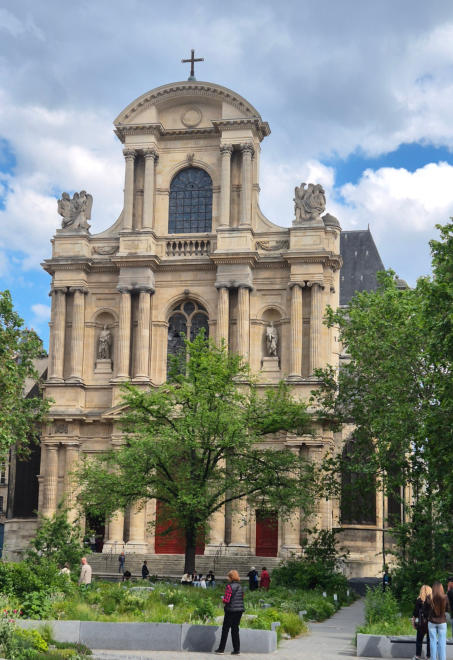
St-Gervais-St-Protais is one of the oldest places of
worship in Paris (6th century) and also among the first
parish churches on the Right Bank. The present church,
built in the 16th and 17th centuries in the Flamboyant
Gothic style, had its façade completed in 1620 — the
very first example of Classical architecture in Paris.
Today, Saint-Gervais–Saint-Protais is entrusted to the
Monastic Fraternity of Jerusalem, whose mother house
is located here in Paris.

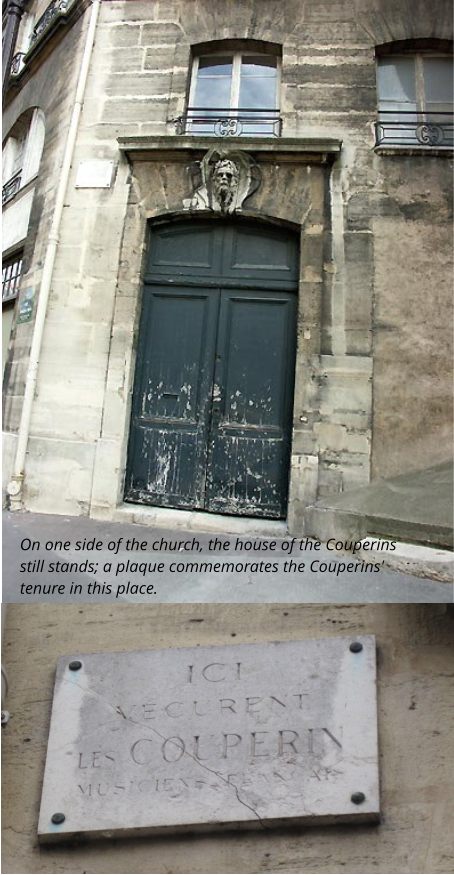
This instrument was the organ of 7 members of the Couperin
family, in 4 generations:
- Louis and his brother Charles from 1653 to 1679
- François "le Grand", interim of Delalande
and his cousin Nicolas from 1665 to 1748
- Armand-Louis, son of Nicolas from 1748 to 1789,
assisted by his younger brother Pierre.
- his son Gervais-François until 1866.

A4
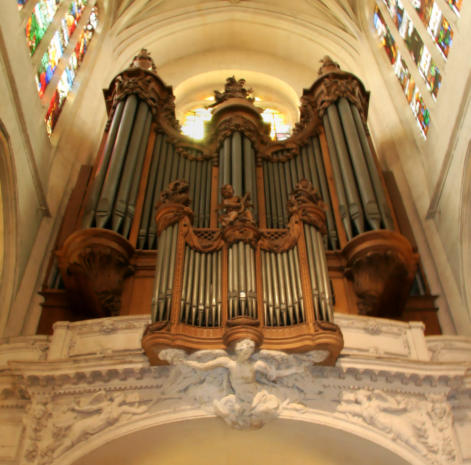
The organ at St. Gervais is one of the oldest in Paris. It was
built by François-Henri Clicquot between 1766 and 1768,
replacing an earlier instrument whose construction began in
1600 by Languedul and was reworked several times by
Thierry. During the new build, Clicquot reused parts from
the old organ.
It was lucky to be preserved without changes through the
19th and 20th centuries, thanks to forward-thinking priests
and organists who recognized its material and historical
value.
It was surveyed in 1812 and 1843 by Dallery, then restored
in 1920–1924 and 1967–1973.
Most of its 41 stops are original, which is remarkable for a
Parisian organ: 17 from the 17th century, 15 from the 18th,
and 5 rebuilt in 1974. Plus, the entire wind supply is
authentic.
1600–1603
A new organ was made by Matthijs Langhedul (21 stops, 2
manuals with short octaves). With the church unfinished, it
went in the south transept gallery. It had about 20 stops
across two 45-note manuals (short octaves) and a 9-note
pedalboard—this forms the basis of today's instrument. The
case likely looked like today's but with three equal-height
towers.
1628
The church was finished, so Pierre Pescheur moved the
organ to the new west gallery. The Positif division went on a
Rückpositiv, with a new keydesk in the window and remade
action. Short octaves were extended to 49 notes, a manual
coupler was added, and tweaks strengthened the organ for
its new spot: a Récit division playing the Grand Cornet,
extending the 16' Principal to low C, revoicing mixtures,
replacing tin-lead reeds with tin pipes, and reharming.
1649–1659
Pierre Thierry added an Echo division with 7 stops, a new
Nasard and Tierce on Positif, and pedal stops. Several stops
were scaled larger. He added C# to Positif, Grand Orgue,
and Pedal for A=440 tuning, plus a mobile Grand-Orgue
pedal coupler—a real innovation. Now 35 stops across 4
manuals and pedal.
1676–1685
Restoration by Alexandre Thierry: added a Récit Cornet, 16'
Bourdon and 2' Quarte de Nazard on Grand-Orgue, 1 1/3'
Larigot on Positif. Pitch raised a half-step (B♭). Manuals
extended to 51 notes on Grand-Orgue and Positif.
1714
François Thierry added an 8' Trumpet to Récit on a vacant
Grand-Orgue slide (replacing 4' Flute); Echo's bass octave
removed for easier maintenance and better touch. Main
case shutters taken off.
1758–1768
Major restoration first by Louis Bessart, then François-Henri
Clicquot after Bessart's 1764 death. The case was restored
and raised to its current form. Layout was revised, but heavy
reuse of old parts (pallets, pipes) made for a smooth
transition. In 1769, Clicquot replaced Positif Cromorne 8'; in
1778, Positif 4' Flute with Clairon 4'.
Clicquot maintained it until his 1790 death, then partner
Pierre Dallery. It narrowly escaped destruction during the
Revolution church closure.
1811
Overhaul by Pierre-François Dallery: removed Grand-Orgue
and Positif mixtures, Positif 1 1/3' Larigot. Added a second 8'
Trumpet (Grosse Trompette) to Grand-Orgue; Positif got a
recycled Bassoon-Clarinet 8' (Clicquot pipes?), with Larigot
pipes partly making a 8' Flute Treble.
1843/54
Louis-Paul Dallery restored Grand-Orgue Plein Jeu VI and
Positif Plein Jeu V; changed first 15 pipes of 16' Principal. In
1854, replaced a damaged façade Principal pipe from a
near-fire.
1909
Joseph Gutschenritter serviced it: action regulation, full pipe
cleaning. Removed second Grand-Orgue 8' Trumpet; its
pipes reused for worn ones on first Grand-Orgue Trumpet
and Pedal Trumpet. Bourdon chimney tops cut for
adjustable caps.
1921–1923
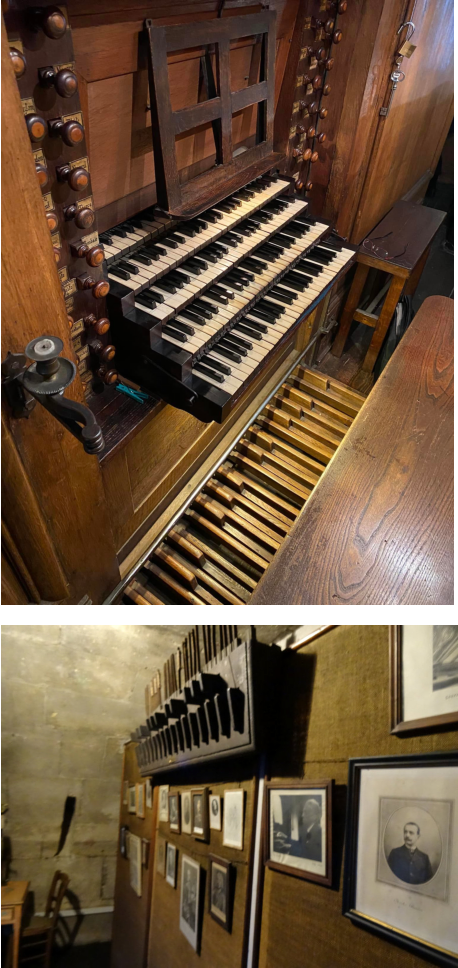
Repairs by Louis Beasse after storm flooding and 1918
bombing damage:
•
Replaced six wedge bellows with modern reservoir
system.
•
Raised keydesk.
•
Added German pedalboard (French one kept).
•
Reworked pedal action.
•
Some pipe ranks still silent; reed pipe swaps continued.
1949–1967
Overhaul by Louis-Eugène Rochesson: reed reclassification,
reopened Grand-Orgue Plein-Jeu stopped pipes, added
recycled 2 2/3' Nasard on vacant Grand-Orgue slide.
1968–1974
Restoration by Danion-Gonzalez to recreate 1768 layout:
•
Grand-Orgue: new Plein-Jeu IX per original pallet chart;
kept Dallery's second 8' Trumpet; new slide for 8' Voix
Humaine.
•
Positif: kept Dallery Plein-Jeu, added chimney 8' Bourdon
Treble, replaced Bassoon-Clarinet with new 1' Larigot.
•
New action.
•
Pedal extended to 27 notes.
•
Case stripping.
All removed stops stored inside case.
2000
Mulheisen cleaned flue pipes, partial reed cleaning,
mechanical repairs and tweaks, full tuning and
temperament adjustment.
Stoplist
Source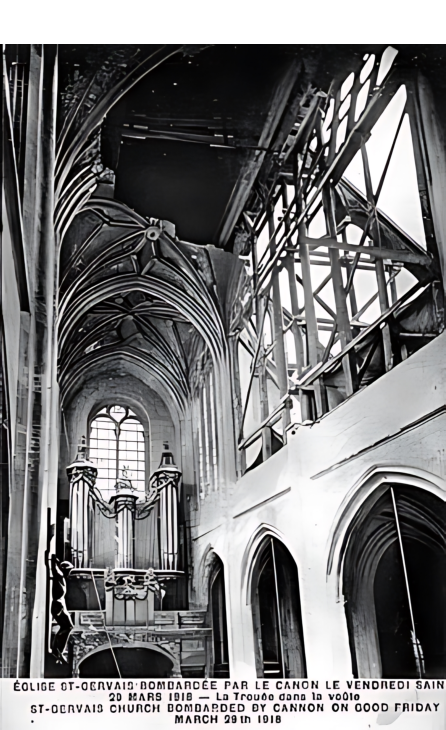

Titular organist
Aude Heurtematte, Nicolas Bucher,
Gaétan Jarry
Grellety Bosviel, Elise Friot (les offices de semaine)
Concerts
Parish website
Video
Frédéric Muñoz
Photos
GO : Jeroen de Haan
Autres photos : Victor Weller
1603 - Matthijs Langhedul (1)
1628 - Pierre Pescheur (5)
1649/59 - Pierre Thierry (2)
1676/85 - Alexandre Thierry (5)
1714 - François Thierry (5)
1758/68 - Louis Bessart & François-Henri Clicquot (3a)
1811 - Pierre-François Dallery (5)
1843/58 - Louis-Paul Dallery (6)
1909 - Joseph Gutschenritter (6)
1923 - Louis Beasse (5)
1949/67
- Louis-Eugène Rochesson (6)
1968/74 - Danion - Gonzalez (4)
2000 - Muhleisen (6)
V/41 - mechanical traction
Stoplist








The organs of Paris


ORGANS OF PARIS © 2026 Vincent Hildebrandt


A4
The organ at St. Gervais is one of the oldest in Paris. It was
built by François-Henri Clicquot between 1766 and 1768,
replacing an earlier instrument whose construction began in
1600 by Languedul and was reworked several times by
Thierry. During the new build, Clicquot reused parts from the
old organ.
It was lucky to be preserved without changes through the
19th and 20th centuries, thanks to forward-thinking priests
and organists who recognized its material and historical
value.
It was surveyed in 1812 and 1843 by Dallery, then restored in
1920–1924 and 1967–1973.
Most of its 41 stops are original, which is remarkable for a
Parisian organ: 17 from the 17th century, 15 from the 18th,
and 5 rebuilt in 1974. Plus, the entire wind supply is
authentic.
1600–1603
A new organ was made by Matthijs Langhedul (21 stops, 2
manuals with short octaves). With the church unfinished, it
went in the south transept gallery. It had about 20 stops
across two 45-note manuals (short octaves) and a 9-note
pedalboard—this forms the basis of today's instrument. The
case likely looked like today's but with three equal-height
towers.
1628
The church was finished, so Pierre Pescheur moved the organ
to the new west gallery. The Positif division went on a
Rückpositiv, with a new keydesk in the window and remade
action. Short octaves were extended to 49 notes, a manual
coupler was added, and tweaks strengthened the organ for
its new spot: a Récit division playing the Grand Cornet,
extending the 16' Principal to low C, revoicing mixtures,
replacing tin-lead reeds with tin pipes, and reharming.
1649–1659
Pierre Thierry added an Echo division with 7 stops, a new
Nasard and Tierce on Positif, and pedal stops. Several stops
were scaled larger. He added C# to Positif, Grand Orgue, and
Pedal for A=440 tuning, plus a mobile Grand-Orgue pedal
coupler—a real innovation. Now 35 stops across 4 manuals
and pedal.
1676–1685
Restoration by Alexandre Thierry: added a Récit Cornet, 16'
Bourdon and 2' Quarte de Nazard on Grand-Orgue, 1 1/3'
Larigot on Positif. Pitch raised a half-step (B♭). Manuals
extended to 51 notes on Grand-Orgue and Positif.
1714
François Thierry added an 8' Trumpet to Récit on a vacant
Grand-Orgue slide (replacing 4' Flute); Echo's bass octave
removed for easier maintenance and better touch. Main case
shutters taken off.
1758–1768
Major restoration first by Louis Bessart, then François-Henri
Clicquot after Bessart's 1764 death. The case was restored
and raised to its current form. Layout was revised, but heavy
reuse of old parts (pallets, pipes) made for a smooth
transition. In 1769, Clicquot replaced Positif Cromorne 8'; in
1778, Positif 4' Flute with Clairon 4'.
Clicquot maintained it until his 1790 death, then partner
Pierre Dallery. It narrowly escaped destruction during the
Revolution church closure.
1811
Overhaul by Pierre-François Dallery: removed Grand-Orgue
and Positif mixtures, Positif 1 1/3' Larigot. Added a second 8'
Trumpet (Grosse Trompette) to Grand-Orgue; Positif got a
recycled Bassoon-Clarinet 8' (Clicquot pipes?), with Larigot
pipes partly making a 8' Flute Treble.
1843/54
Louis-Paul Dallery restored Grand-Orgue Plein Jeu VI and
Positif Plein Jeu V; changed first 15 pipes of 16' Principal. In
1854, replaced a damaged façade Principal pipe from a near-
fire.
1909
Joseph Gutschenritter serviced it: action regulation, full pipe
cleaning. Removed second Grand-Orgue 8' Trumpet; its pipes
reused for worn ones on first Grand-Orgue Trumpet and
Pedal Trumpet. Bourdon chimney tops cut for adjustable
caps.
1921–1923
Repairs by Louis Beasse after storm flooding and 1918
bombing damage:
•
Replaced six wedge bellows with modern reservoir
system.
•
Raised keydesk.
•
Added German pedalboard (French one kept).
•
Reworked pedal action.
•
Some pipe ranks still silent; reed pipe swaps continued.
1949–1967
Overhaul by Louis-Eugène Rochesson: reed reclassification,
reopened Grand-Orgue Plein-Jeu stopped pipes, added
recycled 2 2/3' Nasard on vacant Grand-Orgue slide.
1968–1974
Restoration by Danion-Gonzalez to recreate 1768 layout:
•
Grand-Orgue: new Plein-Jeu IX per original pallet chart;
kept Dallery's second 8' Trumpet; new slide for 8' Voix
Humaine.
•
Positif: kept Dallery Plein-Jeu, added chimney 8' Bourdon
Treble, replaced Bassoon-Clarinet with new 1' Larigot.
•
New action.
•
Pedal extended to 27 notes.
•
Case stripping.
All removed stops stored inside case.
2000
Mulheisen cleaned flue pipes, partial reed cleaning,
mechanical repairs and tweaks, full tuning and temperament
adjustment.
Stoplist
Source
Titular organist
Aude Heurtematte, Nicolas Bucher,
Gaétan Jarry
Grellety Bosviel, Elise Friot (les offices de semaine)
Concerts
Parish website
Video
Frédéric Muñoz
Photos
GO : Jeroen de Haan
Autres photos : Victor Weller
1603 - Matthijs Langhedul (1)
1628 - Pierre Pescheur (5)
1649/59 - Pierre Thierry (2)
1676/85 - Alexandre Thierry (5)
1714 - François Thierry (5)
1758/68 - Louis Bessart & François-Henri Clicquot (3a)
1811 - Pierre-François Dallery (5)
1843/58 - Louis-Paul Dallery (6)
1909 - Joseph Gutschenritter (6)
1923 - Louis Beasse (5)
1949/67
- Louis-Eugène Rochesson (6)
1968/74 - Danion - Gonzalez (4)
2000 - Muhleisen (6)
V/41 - mechanical traction
Stoplist

